English
Prices without taxes.
Enseña este producto a quien tú quieras.
Tile
Pool mosaics are small decorative mosaics, with high resistance properties and great design possibilities: a very suitable material for forming patterns and combining colours. Due to their inalterability, easy cleaning and installation, they are the ideal decorative coating for covering swimming pools, facades, columns, interiors, bathrooms, etc. With the use of glass and colour, more decorative and evocative solutions are achieved.
The product is presented in 315 x 315 mm plates for the paper and mesh format and in 317 x 396 mm for the silicone dot format.
The pieces are glued on gummed paper, on fiberglass and polyester in mesh format and with silicone dots.
If you're not sure which format to choose, check out our guide.
If you need to generate a specific color composition for meshes or valances, visit the following link to generate it: Generate combinations. Send us this information and we will send you the quote.
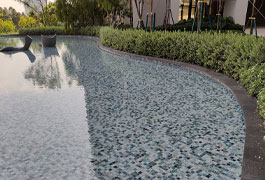
Collection of mosaic tiles for swimming pools that is characterized by its glossy finish and its combination of different shades of color within each mosaic.
Vitreous coating ideal for pools, bathrooms and other wet areas. It is characterized by its uniform surface and absence of streaks or striations, which gives it a clean and minimalist look
Known as mosaic mix, it is a popular choice for lining swimming pools, bathroom walls and other surfaces. It is characterized by its combination of tesserae of different colors, generally within the same chromatic range
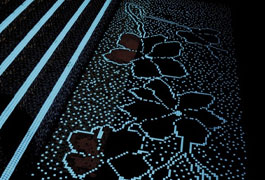
Also known as phosphorescent mosaic tile, it is a type of mosaic that absorbs light during the day, whether natural or artificial, and emits it in the dark.
Decorative elements that are used to beautify and personalize swimming pools. They are made up of small pieces of colored glass that are placed on the surface of the pool pool, creating unique designs and patterns.
Mosaic of national manufacture, of 1st quality
Vitreous mosaic - Mosaic tiles for swimming pools and bathrooms
The use of mosaic began more than 2000 years ago, with the intention of creating environments and images that would last over time. Unalterable and indestructible, starting from glass after complex manufacturing processes, a material of the highest quality is achieved, which successfully defies time and erosion.
The vitreous coating does not lose its gloss or color, always maintaining a good appearance, while other coatings tend to acquire a dull and matte appearance over time.
The mosaic tile is resistant to chemicals, both acid and alkaline, which facilitates cleaning.
The coefficient of thermal expansion of the gressite is minimal, ensuring uniformity in the joints.
It is easy to apply, which provides a better work finish.
What tile to choose for the pool
There are several formats of pool tile :
Tile on paper: The tiles of the tile are glued on a piece of paper, which once the cement has set, is removed and cleaned. This model of pool tile is the most economical
Mesh tile: Mosaic mesh is a support that is placed behind the tile and is similar to a spider's web. It holds the tile sheet together and nothing needs to be removed once the glue cement has set.
Mosaic tile in silicone dots: This support makes each tile of the tile attached to the one next to it thanks to a silicone dot. Like mesh tile, nothing needs to be removed once it has been placed.
Frequently asked questions
- Preparar la superficie sobre la que vas a colocar el gresite, limpiándola de polvo y suciedad y comprobando que no esté húmeda.
- Obtener la mezcla de cemento cola especial para material vítreo, siguiendo los pasos del fabricante. No vale cualquier cemento cola.
- Extender la capa de cemento cola con una llana dentada.
- Coloca las capas de gresite con cuidado y de forma alineada.
- Usa una llana de goma para golpear el gresite y fijarlo bien a la capa de cemento cola.
- Limpia los restos del cemento cola sobrante.
- Respeta los tiempos de secado antes de rellenar las separaciones del gresite con el rejuntado.
- Limpia los restos del rejuntado.
- Una vez haya transcurrido el tiempo de secado indicado por el fabricante, ¡es hora de disfrutar de tu piscina!
Por normal general, el gresite se vende en cajas de 2 metros cuadrados. Cada placa de gresite tiene unos 32cm de ancho y largo y está formada por teselas unidas entre sí.
Esta unión puede estar realizada de diferentes maneras:
- Unión mediante puntos de silicona: Las teselas están unidas entre sí por pequeños puntos de silicona que quedan enterrados en el cemento cola una vez pegadas las placas de gresite.
- Unión mediante malla: una malla une las teselas por la parte trasera, quedando esta malla tapada por el cemento cola una vez colocada.
- Unión en papel: las teselas están pegadas por la parte superior a un trozo de papel que, una vez pegada la placa, se elimina fácilmente quedando a la vista el gresite.
No. No debería ser el mismo. El mortero que está como rejuntado está expuesto de forma continua al agua y a los productos químicos disueltos en la misma, además de los rayos solares, por lo que es el mortero que sufre mucho más con el tiempo.
Existen morteros específicos para el rejuntado, por lo que usar un cemento cola básico para el rejuntado no es recomendable. Queda bien al principio, pero dura poco.
Recomendamos usar cemento cola específico para rejuntado. Cuando más resina epoxi tenga, más durará manteniendo sus propiedades.
Sí. Existen productos en el mercado aptos para esta función. Actualmente recomendamos el adhesivo de Fischer MS Especial Piscina, que sella, pega y rellena tanto en piscinas con agua clorada como en salina, directamente bajo el agua.
El gresite antideslizante solo se suele usar en las zonas de acceso o salida de la piscina como las escaleras y las zonas de playa externas muy cercanas a la salida. Para el resto de las zonas de la piscina, suelo y pared, se suele usar el gresite sin antideslizamiento.
Lógicamente en los platos de ducha se debe usar el gresite antideslizante.